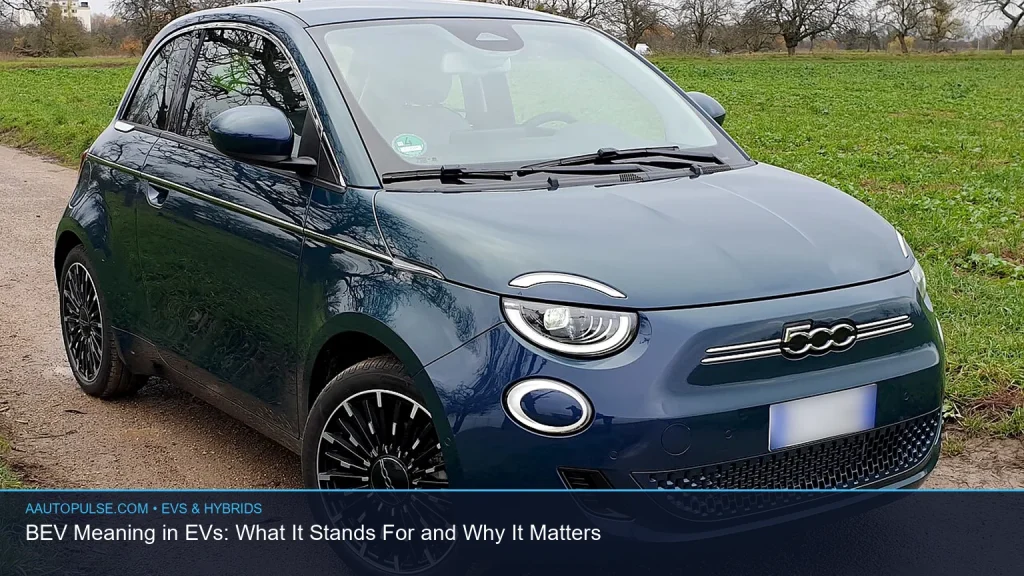
If you’ve seen BEV in EV articles and wondered about the bev meaning, it stands for Battery Electric Vehicle. In simple terms, a BEV runs only on electricity stored in a battery and does not use a gas engine. That makes it different from hybrids and plug-in hybrids. In this guide, you’ll learn what a BEV is, how it works, how it compares with other EV types, and why the term matters when you are researching or shopping for an electric vehicle.
📖 Table of Contents
📌 Key Takeaways
- BEV means Battery Electric Vehicle, a vehicle powered only by electricity.
- A bev electric vehicle has no gasoline engine, so it needs charging instead of fuel.
- Understanding BEV terms helps you compare EV types, charging needs, and ownership costs more clearly.
- If you are shopping for an EV, knowing the difference between a BEV, hybrid, and plug-in hybrid can help you choose the right fit.
What Does BEV Mean in EVs?
The bev meaning is straightforward: Battery Electric Vehicle. A BEV vehicle is powered only by a rechargeable battery and an electric motor. It does not have a gas tank, exhaust pipe, or engine that burns fuel.
When people say “electric car,” they often mean a BEV. The term is common in automotive writing, government resources, and dealer listings because it clearly separates full electric models from hybrids and plug-in hybrids.
Why the term matters
The label matters because not all electrified vehicles work the same way. Some vehicles use both gasoline and electric power, while a BEV uses only electricity. If you know the terminology, you can better understand range, charging, maintenance, and ownership costs.
How a BEV Works

A BEV stores electricity in a battery pack. That battery sends power to an electric motor, which turns the wheels. The system is simpler than a traditional gas drivetrain because it has fewer moving parts.
Instead of filling up at a gas station, you recharge a BEV at home, at work, or at a public charging station. Charging speed depends on the charger type, the vehicle’s battery size, and the car’s onboard charging limits.
Main parts of a BEV
- Battery pack: Stores electrical energy.
- Electric motor: Converts energy into motion.
- Power electronics: Manage how electricity flows.
- Charging port: Connects the vehicle to a charger.
- Thermal system: Helps keep the battery at a safe operating temperature.
Because a BEV has fewer mechanical parts than a gas vehicle, routine service needs may be different. That said, owners should still check brakes, tires, coolant systems, and cabin filters based on the vehicle’s owner’s manual.
BEV vs Hybrid vs Plug-In Hybrid: What’s the Difference?
Many shoppers search for “bev meaning” because they want to tell BEVs apart from other electrified vehicles. The easiest way is to look at what powers the wheels and whether the vehicle can run on gasoline.
| Vehicle Type | Power Source | Gas Engine? | How It Refuels/Recharges |
|---|---|---|---|
| BEV | Battery + electric motor | No | Charges from electricity |
| Hybrid | Gas engine + electric assist | Yes | Refuels with gasoline |
| Plug-in Hybrid (PHEV) | Battery + electric motor + gas engine | Yes | Charges and refuels |
Selection criteria: how to choose the right type
- Choose a BEV if you want zero tailpipe emissions and can charge regularly.
- Choose a hybrid if you want better fuel economy without plugging in.
- Choose a PHEV if you want short electric driving for errands but still need gas for longer trips.
Strengths and limitations
- BEV strengths: quiet driving, no gas use, and fewer routine engine-related services.
- BEV limitations: charging time, range planning, and access to charging infrastructure.
- Hybrid strengths: easy refueling and strong efficiency without charging.
- Hybrid limitations: still relies on gasoline and has more drivetrain complexity than a BEV.
Verdict: If you want the simplest path to all-electric driving, a BEV is the right choice. If you are not ready to depend on charging alone, a hybrid or PHEV may be a better fit.
Why BEV Meaning Matters for Buyers and Shoppers
Knowing the bev meaning helps you avoid confusion when comparing vehicles. Some listings use broad terms like EV, but the details underneath can be very different. A BEV vehicle gives you full electric driving, while other “EVs” may still use gasoline.
This matters for your daily routine too. If you drive mostly short commutes and can charge at home, a BEV can be a strong match. If you often drive long distances with limited charging access, you may want to compare BEVs with PHEVs or hybrids more carefully.
What to check before buying a BEV
- Driving range: Make sure the vehicle can handle your daily needs with a buffer.
- Charging access: Confirm whether you can charge at home, at work, or nearby.
- Charging speed: Look at AC and DC fast-charging support.
- Weather impact: Cold and heat can affect range, so plan for real-world use.
- Warranty and maintenance: Review battery coverage and service intervals in the owner’s manual.
Common Misunderstandings About BEVs
One common mistake is assuming all EVs are the same. A BEV is fully electric, but some vehicles labeled as EVs may still use gas for part of the drive. That difference changes how you charge, how you travel, and what kind of upkeep you need.
Another myth is that BEVs require no maintenance at all. While they usually avoid oil changes and exhaust repairs, they still need tire rotations, brake checks, fluid checks, software updates, and battery system care.
Quick troubleshooting table for new BEV shoppers
| Question | What It Usually Means | What To Do |
|---|---|---|
| Do I need to plug in every day? | Depends on your commute and battery size | Match charging habits to your driving pattern |
| Will winter reduce range? | Often yes, to some degree | Plan extra charging margin in cold weather |
| Do BEVs need oil changes? | Usually no engine oil changes because there is no gas engine | Follow the maintenance schedule in the manual |
How BEVs Fit Into the EV Market
In the U.S., BEVs are a major part of the move toward cleaner transportation. You may see them described in news coverage, government policy, and consumer guides because they represent the fully electric side of the market.
If you are reading reviews, the term BEV helps separate fully electric models from plug-in hybrids and gas-assisted options. That makes comparison easier and helps you understand the real ownership experience before you buy.
Why automakers use the BEV label
Automakers use the label because it is precise. It tells buyers that the vehicle is battery-powered only, which affects everything from charging habits to fuel savings and long-term upkeep. For researchers and shoppers, that precision is useful.
FAQ About BEV Meaning
Is a BEV the same as an EV?
Not exactly. A BEV is one type of EV, but the term EV can also include hybrids and plug-in hybrids in casual use. If you want fully electric driving, look for the BEV label.
What does BEV stand for in a car listing?
BEV stands for Battery Electric Vehicle. It means the car runs only on electricity and does not use gasoline.
Are BEVs cheaper to maintain?
They can be simpler to maintain in some areas because they do not have engine oil changes, exhaust systems, or many traditional engine parts. Still, maintenance needs vary by model, so check the owner’s manual for exact intervals.
Can a BEV vehicle go long distance?
Yes, many can, but long-distance travel depends on the vehicle’s range and charging access. It helps to plan charging stops before a road trip.
Why do people search for bev electric vehicle?
People often use that phrase when they want the plain-English meaning of BEV and want to confirm they are researching a fully electric vehicle, not a hybrid or plug-in hybrid.
Conclusion: The Bottom Line on BEV Meaning
The bev meaning is simple, but it matters a lot: BEV means Battery Electric Vehicle, a vehicle powered only by electricity. Understanding that term helps you compare EVs with confidence, choose the right charging setup, and set realistic expectations for range and ownership.
If you are exploring an electric vehicle, start by checking whether it is a BEV, hybrid, or plug-in hybrid. Then review charging access, driving needs, and the owner’s manual so you can make a smarter choice for your daily life.