Finding dependable cars for sale in colorado springs requires a clear plan. Between steep mountain grades, rapid winter freezes, and high elevations above 6,000 feet, vehicles along the Front Range face unusual wear. Whether you want an all-wheel-drive crossover for winter commutes along I-25 or a compact commuter car, knowing where to look and what to check saves you time and money. This guide covers local buying options, mechanical inspection priorities, and county paperwork rules so you can buy your next vehicle with total confidence.
📖 Table of Contents
- What Makes Driving in the Pikes Peak Region Different?
- Where to Shop for Cars for Sale in Colorado Springs
- Choosing the Right Drivetrain: AWD, 4WD, or FWD?
- Mechanical Checklist for Used Cars in Colorado Springs
- Navigating El Paso County Paperwork and Emissions
- Safety Ratings and Reliability Verification
- Frequently Asked Questions
- Final Steps to Secure Your Next Car
📌 Key Takeaways
- High elevation thins the air, making turbocharged engines and healthy cooling systems vital for reliable mountain driving.
- Colorado roads use liquid de-icers like magnesium chloride, which makes a detailed undercarriage rust check essential.
- All-wheel drive helps with traction, but dedicated winter tires are what truly provide stopping power on icy hills.
- Always schedule an independent pre-purchase inspection and verify emissions requirements before you sign a bill of sale.
What Makes Driving in the Pikes Peak Region Different?
Colorado Springs sits over a mile above sea level. This altitude affects vehicle mechanics in ways flatland buyers rarely consider. Naturally aspirated engines lose roughly three percent of their power for every 1,000 feet of elevation. In town, that means a standard engine produces roughly 18 to 20 percent less power than it would at sea level.
Winter road maintenance is another factor. The city and state highway crews frequently apply liquid magnesium chloride and sand to melt snow on major routes like Highway 24 and Powers Boulevard. While magnesium chloride is gentler than traditional rock salt, it still creeps into electrical connectors, brake lines, and suspension joints over time. A reliable vehicle in this area must have a clean chassis and a cooling system capable of handling steep climbs under thin atmospheric pressure.
Where to Shop for Cars for Sale in Colorado Springs
When searching for reliable transport, you have three main avenues: franchise dealerships, independent used car lots, and private parties. Each channel offers distinct trade-offs between buyer protection, convenience, and final price.
Franchise dealers typically offer newer inventory and certified pre-owned (CPO) vehicles. These models pass multi-point inspections and carry factory-backed warranties. Independent dealerships offer a wider spread of price points, but vehicle quality varies widely. Private sellers often offer the lowest prices because there is no dealer overhead, but the vehicle comes strictly as-is with no return policy.
| Seller Type | Strengths | Limitations | Best For |
|---|---|---|---|
| Franchise Dealerships | CPO warranties, verified history, on-site service centers. | Higher prices, dealer handling fees, firm negotiation limits. | Buyers seeking late-model vehicles with warranty protection. |
| Independent Lots | Broad inventory, flexible terms, diverse price ranges. | Variable prep standards, third-party warranties can be limited. | Budget-conscious shoppers wanting moderate financing options. |
| Private Sellers | Direct price bargaining, personal service records available. | No warranty, cash or private loan required, full fraud risk. | Experienced buyers looking for the lowest purchase price. |
The Verdict: If you want minimal risk and mechanical protection, choose a franchise CPO inventory. If you are handy, work with a trusted mechanic, and prioritize low acquisition cost, a private seller with full maintenance records is your best choice.
Choosing the Right Drivetrain: AWD, 4WD, or FWD?
Many drivers assume an all-wheel-drive (AWD) or four-wheel-drive (4WD) system is mandatory in Colorado Springs. That is not entirely true. While AWD provides meaningful traction during sudden spring blizzards on steep roads like Academy Boulevard, tire selection matters just as much as driven wheels.
- All-Wheel Drive (AWD): Best for general passenger cars and crossovers. It shifts power automatically when wheels slip without requiring driver intervention. Ideal for changing winter street conditions.
- Four-Wheel Drive (4WD): Best for trucks and rugged SUVs. It features a locked transfer case designed for deep snow, unpaved mountain trails, and heavy towing. It should not be used on dry pavement.
- Front-Wheel Drive (FWD): Completely viable for city commuting when paired with dedicated winter tires. The weight of the engine rests over the drive wheels, providing adequate starting traction on mild grades.
Keep in mind that AWD helps a vehicle accelerate, but it does not shorten stopping distances on packed ice. A front-wheel-drive car fitted with three-peak mountain snowflake (3PMSF) rated winter tires often outperforms an all-wheel-drive vehicle on worn all-season tires.
Mechanical Checklist for Used Cars in Colorado Springs
Before making an offer on any of the used cars in colorado springs, conduct a hands-on inspection. Local operating conditions place specific stresses on mechanical systems that standard checklists might overlook.
1. Undercarriage and Brake Lines
Crawl under the car with a bright flashlight. Check the subframe, control arms, exhaust welds, and brake lines. Surface oxidation is common, but deep flaky scaling indicates extensive winter road chemical exposure. Replacing corroded steel brake lines can cost hundreds of dollars.
2. Cooling and Heating Systems
High climbs strain engine cooling. Check the radiator, hoses, and coolant reservoir for dried white or colored residue, which signals past leaks. Verify that the cabin heater blows hot air quickly. A clogged heater core is costly to repair because it often requires removing the entire dashboard.
3. Brake Condition and Rotor Wear
Slowing down when descending Ute Pass or coming down from Woodland Park wears out brake pads and warps rotors rapidly. During your test drive, brake firmly from 50 mph on a clear stretch of road. Any vibration in the steering wheel or brake pedal signals warped front brake rotors.
4. Suspension Components
Freeze-thaw cycles create severe potholes on Front Range roads every spring. Listen for clunks or rattles when driving over bumps. Bounce each corner of the vehicle while parked; it should settle immediately without bouncing repeatedly, confirming that the shock absorbers are functional.
Navigating El Paso County Paperwork and Emissions
Buying a car involves legal requirements that differ by county. In Colorado, clean paperwork is critical before handing over payment.
First, examine the vehicle title closely. Ensure the seller’s name matches their government ID exactly. Never accept a title where the seller has not titled the car in their own name—a practice known as “title jumping.” Verify that the title is free from active liens. If a bank holds a lien, you must obtain an official lien release letter before the El Paso County Clerk and Recorder will issue a new title in your name.
Second, check emissions rules. El Paso County does not currently require routine biennial emissions testing for vehicle registration, unlike neighboring Denver and Boulder counties. However, if you commute regularly into the Denver metro area, or if you purchase a vehicle from an emissions-controlled county, ensure the catalytic converters are intact. Replacing stolen or missing catalytic converters with factory-compliant units can cost thousands of dollars.
Safety Ratings and Reliability Verification
Never rely solely on a visual inspection. Combine your evaluation with independent safety and service records. Start by obtaining a vehicle history report through Carfax or AutoCheck. Look for continuous oil change intervals, regular mileage increases, and whether the vehicle was ever declared a total loss or issued a salvage/rebuilt title.
For safety performance, cross-reference the vehicle model year with standard testing agencies:
- National Highway Traffic Safety Administration (NHTSA): Look for models earning an overall 5-Star Safety Rating, with strong scores in frontal and rollover crash categories.
- Insurance Institute for Highway Safety (IIHS): Check for vehicles named a “Top Safety Pick” or “Top Safety Pick+”. These vehicles demonstrate superior roof strength, side-impact protection, and effective headlight performance for dark mountain corridors.
Finally, review realistic maintenance schedules. Most modern vehicles require engine oil changes every 5,000 to 7,500 miles, transmission fluid refreshes every 30,000 to 60,000 miles, and spark plug replacements around 100,000 miles. Always verify these specifications against the manufacturer’s original owner’s manual for the exact model you intend to purchase.
Frequently Asked Questions
Do I need an all-wheel-drive car to live in Colorado Springs?
No, all-wheel drive is not mandatory. Many residents drive front-wheel-drive cars year-round. However, if you drive a front-wheel-drive vehicle, you should invest in quality winter tires between November and April. High-clearance AWD or 4WD vehicles are recommended if you live on steeper hills, unpaved roads, or plan frequent mountain ski trips.
How do I verify a vehicle is free of rust damage?
Inspect the lower rockers, door bottoms, wheel wells, and subframe components with a flashlight. Look specifically at brake lines and exhaust brackets. If you are unsure, pay an independent automotive shop $100 to $200 for a pre-purchase inspection on a hydraulic lift before finalizing your purchase.
Are private car sales subject to sales tax in Colorado Springs?
Yes. Even if you purchase from a private individual without paying tax at the curb, you must pay the applicable state, county, and city sales tax when you register the vehicle at the El Paso County motor vehicle office. Budget approximately 7 to 9 percent extra on top of your purchase price to cover taxes and registration fees.
What should I check on an older high-mileage vehicle?
On vehicles with more than 100,000 miles, check when the timing belt (if equipped) was last replaced. Water pumps, alternator output, suspension bushings, and valve cover gaskets should also be inspected carefully. Ask the seller for physical receipts showing documented fluid services.
Final Steps to Secure Your Next Car
Finding a dependable vehicle along the Front Range comes down to thorough preparation. Set a realistic budget that includes local registration fees, purchase taxes, and an immediate fluid service. Narrow your search to models with strong safety ratings, pull a comprehensive vehicle history report, and never bypass a third-party mechanical inspection. By taking these methodical steps, you will secure a car built to handle Colorado terrain safely for years to come.
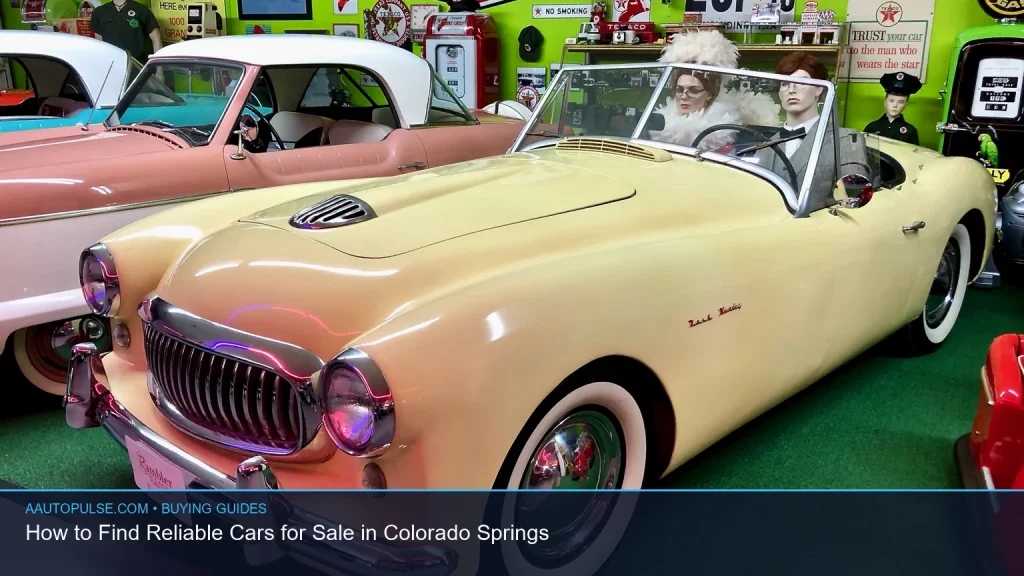
Featured image: Photo: CZmarlin — Christopher Ziemnowicz, a photo credit would be a / CC BY-SA 4.0 via wikimedia